
ZEISS Materials Research Upright Microscopes
-
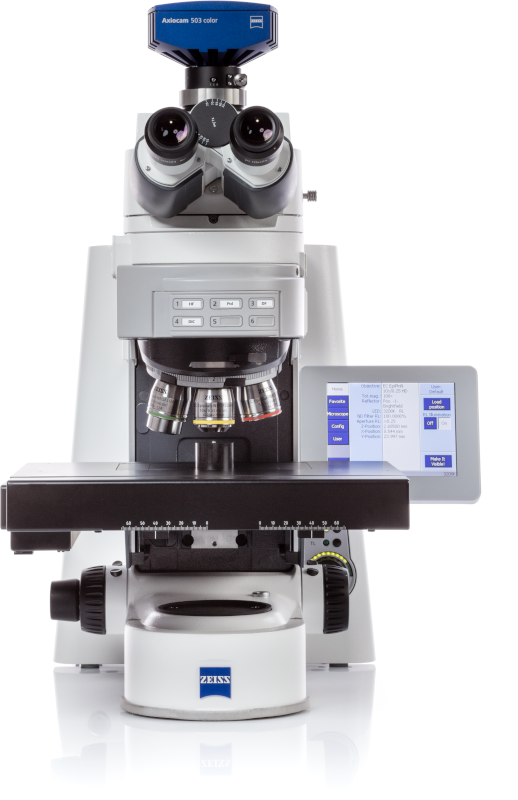
Axio Imager
Research & Automated Materials Analysis -

Axio Imager Vario
Large-Sample Inspection -

Axioscope 5/7
Advanced Routine & Quality Control -

Axiolab 5
Compact Routine Materials Microscopy


What Is an Upright Materials Microscope?
Upright microscopes are a versatile platform for materials inspection, metallography, electronics, quality control, and research. Unlike inverted microscopes, where the objectives are positioned below the sample, upright microscopes observe the specimen from above. This configuration is ideal for prepared metallographic samples, wafers, electronic components, geological specimens, coatings, and other samples that can be positioned beneath the objective.
ZEISS upright materials microscopes range from compact routine inspection systems to fully motorized research platforms, allowing laboratories to select the level of imaging, contrast, automation, and sample capacity required for their application.
Why Choose an Upright Microscope?
-

Versatile Sample Types
Upright microscopes accommodate a wide range of specimens, including metallographic mounts, wafers, electronic components, geological thin sections, whole parts, and other prepared materials. This makes them a flexible choice for multi-purpose materials laboratories.
-

Access Your Sample from Above
Some specimens cannot be inverted for inspection. Upright microscopes allow wafers, electronic devices, circuit boards, assemblies, and other samples to remain face-up while the objectives access the surface from above.
-

Multiple Contrast Techniques
Upright microscopes can support a broad range of reflected- and transmitted-light techniques, including brightfield, darkfield, DIC and polarization. Advanced configurations can also incorporate fluorescence and other specialized imaging methods such as laser scanning or Total Interference Contrast (TIC).
-

Routine Through Advanced Workflows
Systems can range from straightforward manual configurations for routine inspection to motorized platforms for automated imaging and quantitative analysis.


What Are Upright Microscopes Used for in Materials Science?
Upright vs. Inverted Microscopes for Materials Science


Should I Use an Inverted or Upright Microscope?
-

Consider an Upright Microscope When…
- You work with a wide variety of specimen geometries
- You need access to the sample from above
- Your specimens fit comfortably beneath the objectives
- Your application requires an upright-specific configuration
-

Choose an Inverted Microscope When…
I want to learn about Inverted Microscopes- You routinely inspect mounted metallographic samples
- You inspect many samples and want fast sample changes
- Your specimens may be large, heavy or irregularly shaped
- Metallography is a major part of your laboratory workflow
- You routinely inspect mounted metallographic samples


Choose the Right Level of Flexibility
-
Axio Imager 2 — Research & Automated Materials Analysis
Explore Axio Imager 2Axio Imager 2 is ZEISS's upright platform for demanding materials microscopy, available in both manual and motorized configurations. For laboratories that need automation, the Axio Imager family can also be configured with motorized components for advanced imaging, repeatable workflows, and quantitative materials analysis.
Best suited for: advanced metallography, materials research, semiconductor and electronics inspection, failure analysis, demanding industrial laboratories, and users seeking a manual or automated microscope. -
Axio Imager Vario — Large-Sample Inspection
Explore Axio Imager VarioAxio Imager Vario extends upright microscopy to applications involving large or tall specimens that cannot be conveniently accommodated by a conventional microscope stand. Its flexible sample space makes it particularly valuable for industrial components, electronics, wafers, and other oversized samples.
Best suited for: large components, semiconductor wafers, electronics, industrial inspection, failure analysis, and applications requiring extended sample clearance. -
Axioscope 5/7 — Advanced Routine & Quality Control
Explore Axioscope 5/7Axioscope provides greater flexibility for laboratories performing a broader range of routine materials applications. Depending on configuration, it can support advanced contrast techniques, digital imaging, and more sophisticated workflows while remaining practical for daily laboratory use.
Best suited for: industrial QC, metallography, electronics, manufacturing laboratories, failure analysis, and multi-user facilities. -
Axiolab 5 — Compact Routine Microscopy
Explore Axiolab 5Axiolab 5 is a compact upright microscope designed for routine materials inspection and documentation. It is a strong choice for laboratories that need reliable ZEISS optics and straightforward operation without the complexity of a highly automated research system.
Best suited for: routine metallography, quality control, education, basic materials inspection, and documentation.